

Nobel Laureate Olga Tokarczuk Receives the Halldór Laxness International Literary Prize, Calls Iceland “a True Literary Nation”
Polish author reflects on Iceland, translation, and a major forthcoming novel during Reykjavik visit
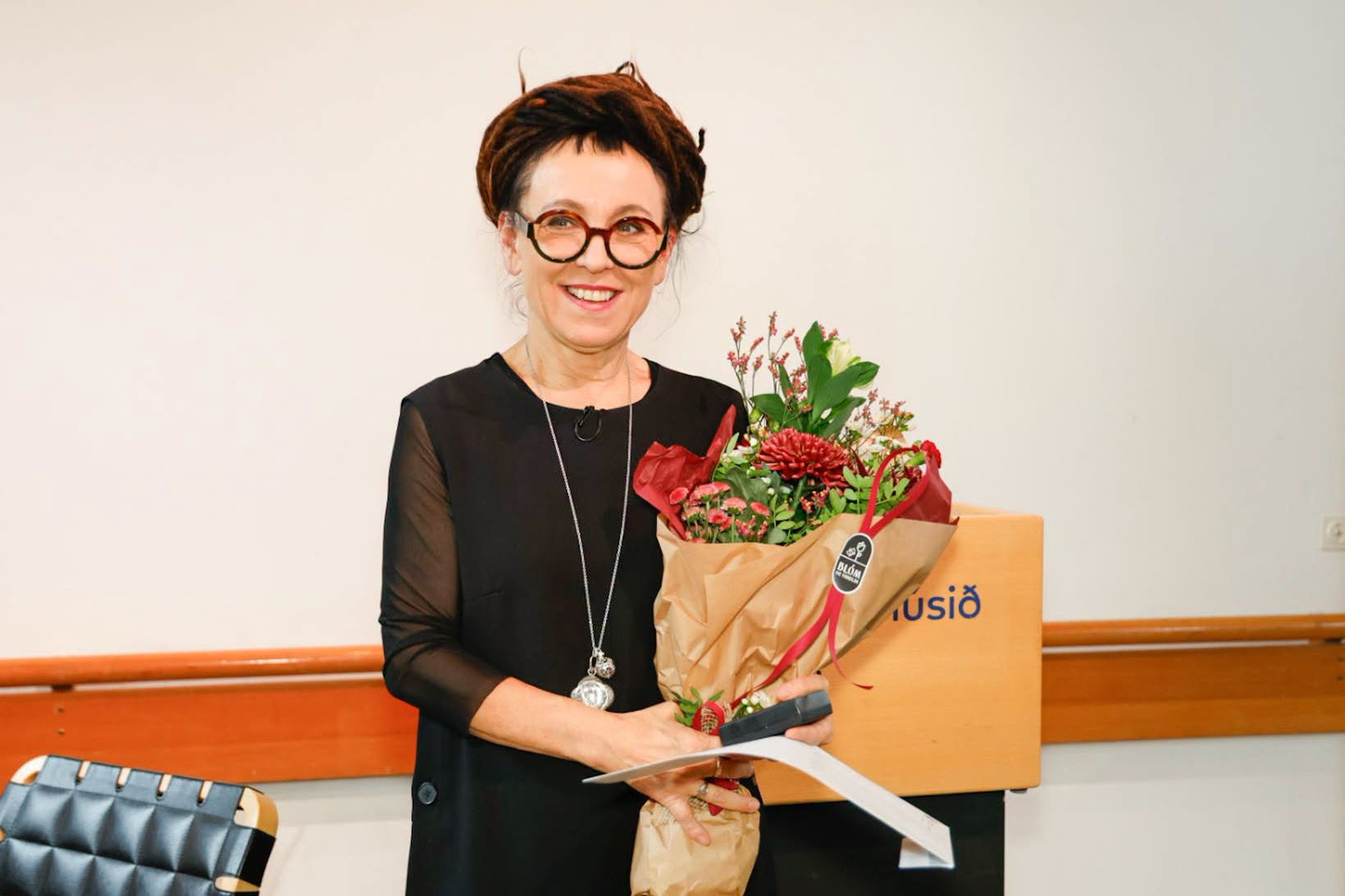
Polish Nobel laureate Olga Tokarczuk has received the Halldór Laxness International Literary Prize 2026, Iceland’s leading international literary honour, at a ceremony at Nordic House in Reykjavík. Iceland’s Minister of Culture, Innovation and Higher Education, Logi Einarsson, presented Tokarczuk with the award of €15,000 and a commemorative prize coin and, recognising her contribution to “the renewal of the art of narrative,” the same wording cited when Halldór Laxness received the Nobel Prize in Literature in 1955.
Speaking to Icelandic newspaper Morgunbladid Daily ahead of the ceremony, Tokarczuk described Iceland as “a true literary nation”, adding that reading and books are held in particularly high regard there. She also spoke of a 2006 visit to Iceland which she said left a lasting impression that later surfaced in fragments of her 2007 novel Flights, winner of the International Booker Prize in 2018. Tokarczuk said she first read Halldór Laxness at around the age of eighteen, and that his novels — among them Iceland’s Bell — left a lasting impression on her.
ON STAGE: ICELAND, BORDERS AND THE FREEDOM OF FICTION
Following the ceremony, Tokarczuk joined Halldór Guðmundsson and Halla Oddný Magnúsdóttir for a conversation on stage. She described her first visit to Iceland twenty years ago in almost mystical terms: “I had a feeling that the land here still has a power to speak to us. It doesn’t exist in Europe, on the continent… You need only to have big ears and to just listen, you know, what the earth is saying, all the time to us.”
She spoke about her invention of the “constellation novel,” the fragmentary structure underlying House of Day, House of Night and Primeval and Other Times – and about the cost of sustained, deeply researched writing, including the eight years spent on The Books of Jacob. Asked about literature’s relationship to fact and historical records, she was unequivocal: “It’s a free country. Literature is still a free country.”
ON TRANSLATION AND UNIVERSAL RESONANCE
Only two of Tokarczuk’s novels have so far appeared in Icelandic: Drive Your Plow Over the Bones of the Dead and House of Day, House of Night. In her Morgunbladid Daily interview, she reflected on how her work travels across languages and cultures, noting that she was struck to see Chinese and Polish readers respond to the same story and grapple with the same questions, and that the international reception of Janina Duszejko, the complex, rebellious protagonist of Drive Your Plow, was something she had not anticipated. She suggested that literature engages with what is universally human; the aspects of our inner lives that unite us, rather than what sets readers in different countries apart.
On the effect of winning the Nobel Prize in 2018, she said that recognition confirms to a writer that readers genuinely exist beyond the solitary act of writing, and that a village she invented on the page had gone on to acquire universal meaning of its own – something she called remarkable. She added that any new freedom she feels as a writer has less to do with the prize itself than with simply growing older.
A MAJOR FORTHCOMING NOVEL
Tokarczuk’s next novel, Świata jest za dużo – an English title has not yet been confirmed, though she suggested during the Reykjavik conversation it might be rendered as There’s Too Much of the World is due in Poland in October 2026. Set in and around Wroclaw in 1946, it follows the unprecedented resettlement of a city and region emptied and repopulated in the aftermath of the Second World War, drawing on her own family’s history in Lower Silesia. She has described it as likely to be her last large-scale novel, citing the physical and creative toll of researching and writing at that scale, and called it a moral obligation to address a gap in the region’s collective memory.
Tokarczuk also addressed the role of literature amid contemporary conflict and political division, arguing that storytelling remains a way to connect seemingly unrelated things and to process crises too large to grasp in the moment – pointing, among other examples, to the enduring pull of ancient narratives such as the Odyssey for confronting present-day violence and moral confusion.
REYKJAVIK PROGRAMME
The day after the ceremony, Tokarczuk read and spoke at the Forlagid Book Store, Reykjavik, alongside Icelandic Polish writers Ewa Marcinek, Mao Alheimsdottir and Jakub Stachowiak, drawing a full house. She has said she deliberately avoids thinking about literature along national lines, describing all literature, regardless of language, as forming a single, unified whole.
SELECTION COMMITTEE AND PREVIOUS LAUREATES
Tokarczuk was selected by a committee comprising author Salman Rushdie, literary critic Egill Helgason, and Stella Soffía Jóhannesdóttir, Chair of the Reykjavík International Literary Festival and Rights Manager at the Reykjavík Literary Agency, that represents the Estate of Halldór Laxness. Speaking on behalf of the committee, Rushdie said:
“Olga Tokarczuk is, quite simply, one of the world’s greatest living writers. In her work we find tragedy, comedy, history, and irony uniting in a completely delightful literary cocktail. I’m very pleased that she has accepted the Laxness prize. Her acceptance is a prize for us all.”
PREVIOUS LAUREATES
Tokarczuk joins a distinguished line of laureates: Ian McEwan (2019), Elif Shafak (2021), Andrei Kurkov (2022), and Salman Rushdie (2024).
ABOUT THE PRIZE
The Halldór Laxness International Literary Prize is presented jointly by the Reykjavík International Literary Festival, the Icelandic Ministry of Culture, Innovation and Higher Education, Business Iceland, Gljufrasteinn Laxness Museum, and Forlagid, the Icelandic publisher of Halldór Laxness. Nordic House was a partner of the 2026 prize.